
FUE Hair Transplant in Tucson, AZ
FUE is available to patients in Tucson and across Arizona. Virtual consultations are offered for patients in Scottsdale, Phoenix, and the broader Phoenix metro who are evaluating FUE with Dr. Keene before traveling to the Tucson clinic.
American Board of Surgery certification

Arizona State Medical Board
Fellow of the American Board of Hair Restoration

American Board of Hair Restoration
Follicular Unit Extraction Hair Transplant in Tucson, AZ
Physician’s Hair Institute in Tucson, Arizona offers Follicular Unit Extraction (FUE) hair transplant surgery performed personally by Dr. Sharon Keene, MD; a female ABHRS Diplomate, American Board of Surgery Diplomate, and ISHRS Past President practicing in Tucson, AZ. Dr. Keene performs one surgical case per day, using the WAW FUE system to ensure precise, surgeon-led graft extraction and placement from first follicle to last.
What is Follicular Unit Extraction Hair Transplant (FUE)?
Follicular Unit Extraction (FUE) is a minimally invasive hair transplant technique in which individual hair follicles are removed one at a time from the donor zone at the back and sides of the scalp, then transplanted into the areas of thinning or loss. Unlike FUT (strip surgery), FUE does not produce a linear scar at the donor site. Instead, each extraction point heals as a small circular mark that is typically undetectable once the surrounding hair grows back.
At Physician’s Hair Institute, FUE is performed using the WAW FUE system, a specialized extraction instrument that minimizes transection (accidental cutting of the follicle) and maximizes graft survival. Dr. Keene performs every step of the procedure personally. There are no technicians handling extraction or placement.
FUE is well suited for patients who prefer no linear scar, who wear their hair short enough that a linear FUT scar would be visible, or who require a smaller total number of grafts. For patients needing larger graft counts across multiple sessions, Dr. Keene evaluates whether FUE, FUT, or a combination approach is most appropriate.
For a detailed comparison of FUE and FUT, see the FUT vs FUE guide.
FUE at Physician's Hair Institute
The surgeon performs the procedure personally
Dr. Keene is present for and personally performs every step of every FUE case at PHI, from the initial site design through extraction and final graft placement. PHI performs one surgical case per day. On the day of your procedure, Dr. Keene’s complete attention is on your case and only your case.
ISHRS Past President and Fellow
Dr. Keene served as President of the International Society of Hair Restoration Surgery, the global professional society that sets clinical standards for the specialty. She is also a Fellow of the ISHRS (FISHRS designation). Both reflect peer recognition from within the surgical community.
Conservative density planning for long-term results
Dr. Keene plans every FUE procedure with the patient’s full hair loss trajectory in mind, not just their current presentation. Donor hair is a finite resource. Surgical planning that does not account for future hair loss can produce results that look unnatural over time. PHI’s conservative density approach is designed to produce a result that looks natural now and remains natural over the next two decades.
FUE Procedure
The donor harvesting technique of follicular unit excision (formerly known as follicular unit extraction) utilizes a small micro punch to excise individual follicular unit grafts. Unlike many clinics today, Dr. Keene performs the FUE procedure herself. She has compared numerous medical devices in order to choose those she has found to be most useful for producing the healthiest grafts. Motorized devices speed the FUE donor removal over removing the grafts manually.
The devices Dr. Keene utilize limit the risk of dehydrating the grafts (as can happen with suction used in some devices) and diminishes transection rates. The WAW machine provides both oscillation and rotation to excise the follicular units (1 to 4 hair grafts) one at a time, with minimal transection, while maintaining vital tissue surrounding the follicles. This helps maintain growth factors present in the tissue around the grafts.
The WAW FUE donor removal technique is demonstrated: Why Dr Devroye’s WAW FUE System Makes The Difference
What You Should Expect Before and During the FUE Procedure?
Why Do You Need a FUE Hair Transplant?
What Are the Advantages of FUE?
Each FUE graft leaves tiny dot scars, and in cases where there are thousands of grafts will leave a thousand small dots, distributed diffusely. However, for patients who prefer to wear their hair in a buzz cut, the small dots created by FUE are typically not visible if the hair is at least 2 mm long. The absence of a linear incision means patients can more quickly return to all degrees of physical activity and athletics without concern for protecting a healing incision. The FUE technique is also advantageous when donor laxity is not sufficient for the strip donor removal method due to prior surgeries.
Patients need to be aware that despite some misleading advertising claims, neither type of donor harvesting technique is completely ‘scarless’. However, the FUE donor removal method results in virtually undetectable scars with a buzz-cut hairstyle, depending on factors such as hair color and skin color contrast.
FUE and the Donor Site: What to Expect
A common description of FUE is that it is ‘scar-free.’ This is not entirely accurate, and it is worth being precise: FUE does not produce a linear scar like FUT. It does produce small circular extraction marks at each follicle removal point. In most patients wearing their hair at normal length, these marks are not visible once the surrounding hair grows back.
In patients who wear their hair extremely short or shaved, the extraction pattern may be visible. Whether this is a concern depends on the patient’s intended hairstyles and the density of the extraction zone. Dr. Keene discusses this during the consultation, using an assessment of your specific donor zone density and your hair length preferences to give you a realistic picture of what to expect.
Using the WAW FUE system, Dr. Keene minimizes the size of each extraction site and maximizes the distance between adjacent extraction points to avoid creating visible patterns in the donor zone. Proper extraction planning is one of the less-discussed but most important factors in a natural-looking FUE result.
Who Is a Good Candidate for FUE?
FUE is typically the right approach for patients who:
- Prefer no linear scar at the donor site, particularly if they wear their hair short at the back and sides
- Have a defined, stable pattern of hair loss with sufficient donor density at the back and sides of the scalp
- Need a moderate total graft count (FUE is most efficient for cases requiring fewer total grafts than a large FUT session would cover)
- Have previously had FUT surgery and want additional grafts extracted from the surrounding donor area
- Are in their 30s or older with a predictable hair loss pattern that allows long-term surgical planning
FUE may not be the right approach for patients who:
- Need a very large total graft count in a single session (FUT typically yields more grafts per procedure)
- Have low donor density that would make individual follicle extraction impractical
- Have diffuse unpatterned hair loss affecting the donor zone as well as the recipient area
Dr. Keene evaluates every patient individually before recommending FUE, FUT, or a combination. Some patients who arrive expecting FUE will be advised that FUT or a combined approach would produce a better result for their specific situation. That recommendation always reflects the patient’s long-term outcome, not the technique the surgeon prefers to perform.
How Much is the FUE Hair Transplant Procedure?
At the Physician’s Hair Institute, we provide a detailed breakdown of the costs for you when you first talk to us so you know what you’re paying for. It’s good to think about the quality of the results and the surgeon’s expertise, not just the price when deciding where to get your FUT transplant.
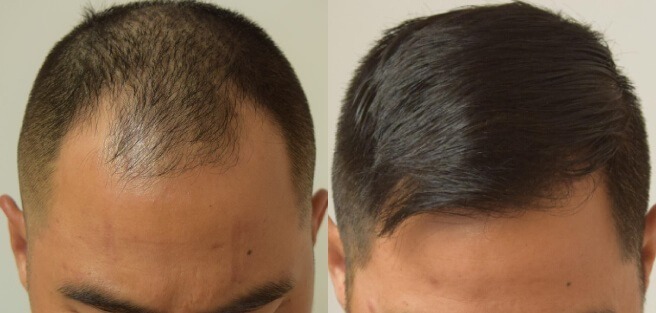
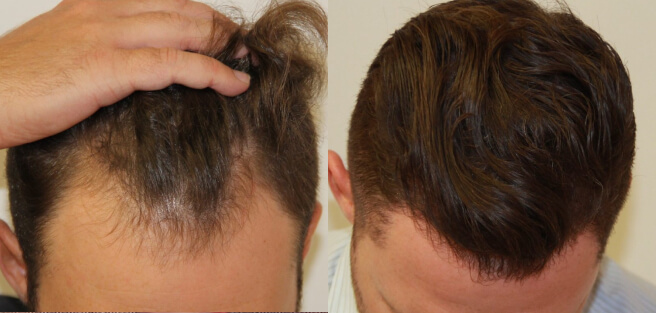
FUE for Tucson, Scottsdale, Phoenix, and Arizona Patients
PHI serves FUE patients from across Arizona, including Tucson, Scottsdale, Phoenix, Tempe, Mesa, and the broader Phoenix metro. The drive from Scottsdale to our Tucson clinic is approximately 1 hour and 45 minutes. Virtual consultations allow out-of-area patients to meet with Dr. Keene, discuss their hair loss, and receive a preliminary candidacy assessment before committing to the trip.
For most out-of-area patients, the FUE evaluation and procedure can be arranged across two visits, or combined into a single extended trip. Dr. Keene’s team will advise on scheduling options during your virtual consultation.

FUE Hair Transplant FAQs
What is FUE hair transplant and how does it work?
FUE (Follicular Unit Extraction) is a technique in which individual hair follicles are removed one at a time from the donor zone at the back and sides of the scalp and transplanted into areas of thinning or loss. Each follicle is extracted with a small circular punch instrument, leaving a tiny round mark that heals and becomes undetectable for most patients wearing normal hair lengths. At PHI, FUE is performed using the WAW FUE system under the direct supervision of Dr. Sharon Keene, MD, from first extraction to final graft placement.
Does FUE hair transplant leave scars?
FUE does not produce a linear scar like the strip method (FUT). It does leave small circular extraction marks at each follicle removal point. For patients wearing their hair at standard lengths, these marks are typically undetectable once surrounding hair grows back. In patients who shave their heads, the extraction pattern may be visible depending on the total number of grafts extracted and how the extraction zone was planned. Dr. Keene uses the WAW FUE system and careful extraction spacing to minimize the visibility of the donor zone for patients who want to keep their options open for very short hairstyles.
What is the WAW FUE system?
The WAW FUE system is a specialized extraction instrument that uses a trumpet-shaped punch tip designed to follow the natural angle of each follicular unit during extraction. This design reduces transection, which is the accidental cutting of the follicle during removal, and helps maximize graft survival rates. Dr. Keene uses the WAW system as part of her standard FUE protocol at Physician’s Hair Institute.
Am I a good candidate for FUE hair transplant?
FUE is well suited for patients with a stable, defined pattern of hair loss, sufficient donor density at the back and sides of the scalp, and a preference for no linear scar. It is particularly appropriate for patients who wear their hair short, patients who need a moderate total graft count, and patients who want the option of adding grafts in future sessions. FUE may not be the most appropriate technique for patients requiring very large graft counts in a single session, for whom FUT often yields more grafts. Dr. Keene evaluates each patient individually and recommends the technique or combination that will produce the best long-term result for their specific situation.
Can patients from Scottsdale and Phoenix get FUE at PHI?
Yes. PHI regularly performs FUE for patients from Scottsdale, Phoenix, Tempe, Mesa, Chandler, and across the Phoenix metro. The drive from Scottsdale to our Tucson clinic is approximately 1 hour and 45 minutes. Virtual consultations are available for out-of-area patients to meet with Dr. Keene, discuss their hair loss, and receive a preliminary candidacy assessment before scheduling an in-person visit. Many Scottsdale-area patients combine the in-person evaluation and procedure into a single extended trip.
How long does the FUE procedure take?
The duration varies, typically ranging from 4 to 8 hours, depending on the number of grafts being transplanted and the type of FUE method used, whether it’s manual or robotic FUE.
Is the FUE result permanent?
Yes, FUE results are permanent, as the transplanted hair follicles are resistant to hair loss.
How long does the FUE recovery take?
Initial recovery is quick, with most people resuming normal activities within a few days, but it may take several months to see the final results.
What is the difference between FUT and FUE?
Follicular Unit Transplantation (FUT) involves removing a strip of scalp and extracting individual hair follicles, leaving a linear scar. On the other hand, FUE involves directly extracting individual follicles from the scalp, resulting in less visible scarring and a quicker recovery.
Are there any side effects associated with FUE hair transplants?
Possible side effects include temporary swelling, bruising, numbness, or tenderness at the transplant sites, but these are generally mild and temporary.
Is FUE a minimally invasive hair transplant procedure?
Yes, FUE is considered minimally invasive, with no stitches required and a faster recovery time compared to FUT.
Do I need to shave my entire head for FUE?
No, full head shaving is not always required for FUE. In some cases, only the donor area is shaved, or small sections may be shaved to allow for the extraction process.